
Jul 23, 2026
In less than a month, Cirion Technologies executed one of the most complex subsea infrastructure recovery operations in Latin America.
Tomorrow marks exactly one month since the June 24 earthquake changed the lives of millions of Venezuelans. Today, 29 days later, Venezuela’s hospitals, businesses and families are back connected.
A world-class infrastructure
For 20 years, Cirion Technologies’ subsea cable operated at an uptime of more than 99.999% — the highest standard in telecommunications. At the time of the earthquake, the cable was fully compliant with its original design specifications.
According to ICPC data¹, 86% of subsea cable breaks in the world are caused by fishing nets and ship anchors. Geological events — earthquakes, subsea landslides — account for between 7% and 14%².
On this occasion, the subsea cable that enters Venezuela was affected by the displacement of the terrain caused by the earthquakes of June 24, 2026.
Preparation and excellence in execution
The recovery of the subsea cable was much more than an engineering operation. It was a race against time that mobilized specialists, technical teams and international capabilities with the same purpose: to restore Venezuela’s international connectivity.
In less than 48 hours, local Cirion teams re-established the Caracas connectivity ring with the support of international partners. Hospitals, banks and food services regained connection within hours. International alternative routes kept more than 60% of customers operational from the first days.
Cirion is a member of ACMA, the international cooperative for the maintenance and repair of subsea cables. There are fewer than 50 specialized cable ships in the world to repair the entire global subsea infrastructure³ — and demand is growing while the fleet is not growing. That membership guaranteed Cirion priority access to the Wave Sentinel and allowed it to be mobilized in record time to Venezuela.
The 15 required government authorizations — which under normal conditions take more than 45 days — were obtained in 14, thanks to the joint work with CONATEL and the Venezuelan authorities.
The result: 29 days from the earthquake to full reconnection. An operation that in other countries has taken from five weeks to several months.
A recovery made possible by working together
Cirion expresses special gratitude to CONATEL and the Venezuelan authorities for the support provided throughout the contingency and for the speed with which they made possible the development of an operation of this complexity.
The permanent coordination between the authorities, our technical teams and the specialized crew of the Wave Sentinel allowed us to meet the planned schedule and return international connectivity to the country under the highest technical and operational standards.
People made it possible
The best technology in the world, without great people, doesn’t work, especially in situations of Crisis.
Behind every technical decision, every test passed and every milestone communicated, there were teams that never stopped – engineers, operators, NOC specialists, the crew of the Wave Sentinel, and Cirion’s collaborators in Venezuela and throughout the region. They are no exception. They are the example of what this company stands for, and all of them mean, we are immensely grateful to them all.
A commitment that continues
Cirion Technologies operates one of the most extensive digital infrastructure networks in Latin America, with more than 105,000 kilometers of fiber optics, 18 landing stations and 6 international subsea cable systems connecting 17 countries. This infrastructure is part of the global Internet connectivity ecosystem and, in Latin America, integrates the regional network inherited from Level 3, today Lumen (AS3356), one of the main Autonomous Systems and Tier-1 backbones in the world.
Thanks to this architecture, Cirion interconnects the region with thousands of Autonomous Systems, cloud providers, content platforms and international operators, guaranteeing high levels of resilience, capacity and availability.
This experience reaffirms Cirion’s commitment to continue strengthening a resilient, secure and highly available digital infrastructure for Latin America.
“We are especially proud of our extraordinary Venezuelan team, whose dedication and resilience represent the best of Cirion. Despite facing personal loss, hardship, and moments of deep grief, they never wavered from their commitment to restoring essential communications to millions of people. His bravery, professionalism and sense of duty were truly heroic and will never be forgotten.” Paul Choiseul – CTIO Chief Technology and Information Officer
Cirion Technologies
Sources
¹ ICPC — International Cable Protection Committee. Submarine Cable Incident Statistics 2010-2024.
² ICPC / UltramapGlobal. Breakdown of causes of rupture: geological and natural events account for between 7% and 14% of total incidents.
³ Industry estimate based on the record of globally active specialized cable vessels.
About Cirion Technologies
Cirion Technologies is a leading provider of digital infrastructure and technology solutions in Latin America. The company operates one of the region’s most comprehensive digital infrastructure platforms, integrating an extensive terrestrial and subsea fiber-optic network, carrier-neutral interconnection services, cloud connectivity, colocation services, and advanced digital solutions. These capabilities enable enterprises, service providers, and hyperscalers to accelerate their digital transformation initiatives across the region.
Press Contact and request for additional photo records
Marcelo Pineda Arango
Global Head of Marketing, Brand & Communications
marcelo.pineda@ciriontechnologies.com
Additional context of the global subsea cable sector:
To understand the challenge of repairing critical subsea infrastructure, we share some recent industry data backed by the ICPC (International Cable Protection Committee) and industry analysts:
- The global network grew by 50%, but ships are scarce: Today there are more than 400 cable systems in operation (about 2.7 million kilometers installed). However, there are only between 60 and 62 cable ships worldwide designed to be installed and repaired. sdxcentral
- Operational capacity at the limit: Much of this global fleet (more than 19 ships) is over 30 years old, and almost no new ships were built between 2004 and 2010. This has created an international “bottleneck” that often delays emergency response times. sdxcentral
- Ruptures are constant globally: The ICPC reports a stable average of approximately 200 ruptures per year worldwide (almost 4 failures per week). The network is now more resilient thanks to better armour, but it is exposed to much greater maritime traffic.
- Main causes of damage: Despite popular belief, 86% of the ruptures are of accidental human origin, generated by commercial trawling nets and boat anchors dragged along the seabed. Geophysical faults (earthquakes and displacements of the seabed) and natural wear occupy second place.
Additional Sources:
- Submarine Cable Networks / SubOptic 2024: “The Future of Submarine Cable Maintenance”. submarinenetworks
- TeleGeography: Recent Reports on Critical Infrastructure and Delays in Optical Laying Projects.
- ICPC (International Cable Protection Committee): Global consolidated annual data on incidents in subsea telecommunications systems. submarinenetworks
- International Telecommunication Union (ITU): Report of the International Advisory Body for Subsea Cable Resilience.itu+1
- ICPC / Global Cable Repair Data Analysis 2024-2025: Presented by Meta and the ICPC, which documents that anchors (14%), trawling (28%) and other unspecified fishing incidents (44%) account for 86% of failures. Geophysical faults represent 7% and plant/equipment failures only 3%.
Jul 22, 2026
The operation enters its final phase with the start of checks prior to the restoration of service.
Specialized teams aboard the Wave Sentinel completed the fusion of both ends of the subsea cable, paving the way for final checks prior to its entry into service.
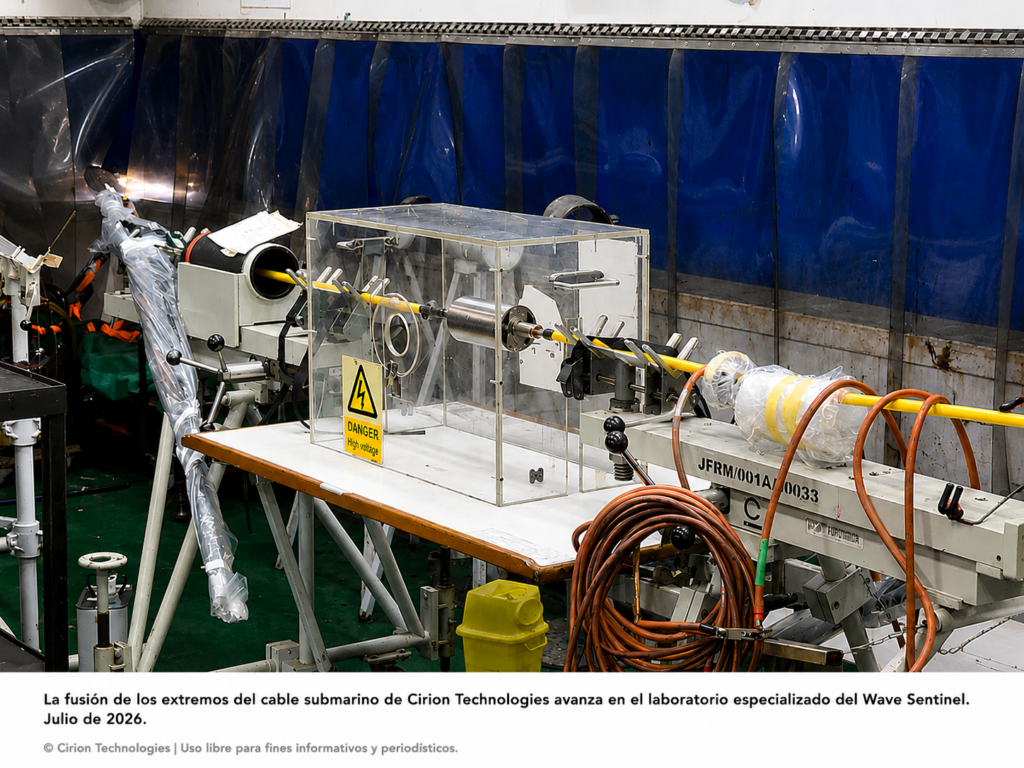
The physical repair of the system is nearing completion
Over the past few days, specialists located, recovered, and prepared both ends of the cable to perform individual optical fiber splicing in the vessel’s specialized laboratory. End-to-end tests confirm connectivity from Venezuela to international connection points in Panama and St. Croix, within original design specifications.
The team now completes the encapsulation of the melt — the final seal that will protect the joint for decades to come.
The precision that sustains connectivity
Behind every international connection there is highly specialized engineering work. The fusion of optical fibers requires microscopic precision to ensure that the system recovers the conditions for which it was designed.
What’s next?
Once the encapsulation is complete, the cable will go through pre-immersion tests tonight to begin international optical verifications.
As has been our practice since the beginning of this contingency, each advance will only be communicated once confirmed by our technical teams.
Paul Choiseul
CTIO Chief Technology and Information Officer
Cirion Technologies
About Cirion Technologies
Cirion Technologies is a leading provider of digital infrastructure and technology solutions in Latin America. The company operates one of the region’s most comprehensive digital infrastructure platforms, integrating an extensive terrestrial and subsea fiber-optic network, carrier-neutral interconnection services, cloud connectivity, colocation services, and advanced digital solutions. These capabilities enable enterprises, service providers, and hyperscalers to accelerate their digital transformation initiatives across the region.
Press Contact and request for additional photo records
Marcelo Pineda Arango
Global Head of Marketing, Brand & Communications
marcelo.pineda@ciriontechnologies.com
Jul 21, 2026
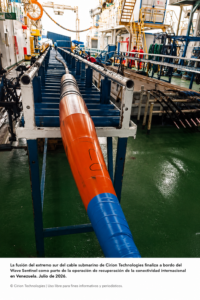
The splicing of the southern end has been completed and the cable returns to the seabed. The northern end is already on board the Wave Sentinel to continue the repair.
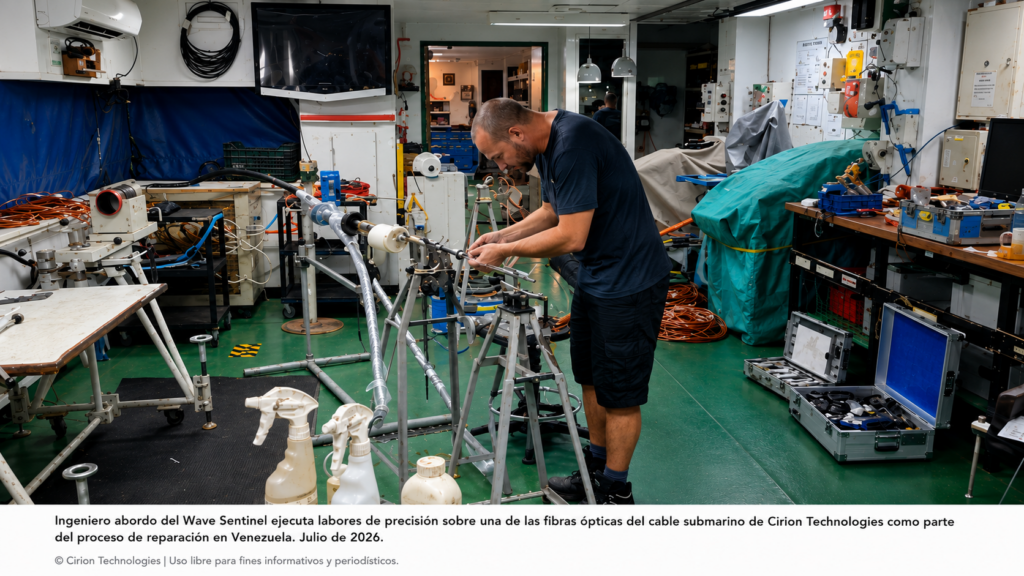
Today, the Wave Sentinel completed the fusion of the southern end of the subsea cable. Inside the ship’s specialized laboratory, a laser system aligned and bonded the fiber-optic filaments — each the thickness of a human hair — with micrometer precision. Once the joint was sealed, the cable was returned to the seabed. The northern end was recovered and is already on board to begin the next merger.
The strength of world-class critical infrastructure
The technical inspections confirm what we already knew: the cable maintains its original design specifications beyond the point of the cut. It has been operating for over 20 years with availability exceeding 99.99%—and continues to demonstrate this performance. Even after facing an extraordinary natural event, the infrastructure maintains its optical and operational characteristics, allowing it to continue operating according to the standards for which it was designed once the repair is completed.
As has been our practice since the beginning, each advance will be communicated only once confirmed by our technical teams.
What’s next?
With the fusion of the southern end already completed and work on the northern end underway, the next stage of the process will consist of finalizing the integration of both sections of the cable.
Paul Choiseul
CTIO Chief Technology and Information Officer
Cirion Technologies
About Cirion Technologies
Cirion Technologies is a leading provider of digital infrastructure and technology solutions in Latin America. The company operates one of the region’s most comprehensive digital infrastructure platforms, integrating an extensive terrestrial and subsea fiber-optic network, carrier-neutral interconnection services, cloud connectivity, colocation services, and advanced digital solutions. These capabilities enable enterprises, service providers, and hyperscalers to accelerate their digital transformation initiatives across the region.
Press Contact and request for additional photo records:
Marcelo Pineda Arango
Global Head of Marketing, Brand & Communications
marcelo.pineda@ciriontechnologies.com
Jul 20, 2026
The technical verifications confirm optimal conditions of the infrastructure to advance in the next stage of the repair. The solution that will restore international connectivity to Venezuela is drawing ever closer.
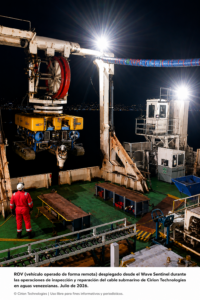 After completing the inspection work on the affected point, the specialized teams managed to recover the two ends of the subsea cable, giving way to a new phase of technical verifications on board the Wave Sentinel
Testing confirms infrastructure integrity
As part of the repair protocol, the teams carried out measurements on both ends of the cable to verify the operating conditions of the infrastructure.
Tests aboard the Wave Sentinel confirmed that both ends of the cable—the one that goes to the Cable Landing Station to the beach, and the one that connects to the Branching Unit to the ocean—maintain a signal within the system’s original design specifications.
These results confirm that the infrastructure retains the expected technical conditions outside the point of impact and allow us to move confidently towards the next stages of the recovery process.
Each advance reduces technical uncertainty
Subsea cable repair operations are progressing sequentially and each stage allows the actual conditions of the infrastructure to be confirmed before the next one is continued.
The recovery of both ends and the validation of their operating parameters represent an important milestone within the intervention, confirming that the system maintains the technical characteristics intended for its operation.
What’s next?
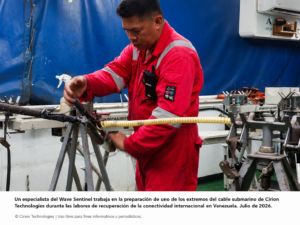
The specialized teams will continue with the next phases of the repair process, in accordance with the international protocols applicable to this type of infrastructure. The solution that will restore international connectivity to Venezuela is getting closer.
As has been our practice since the beginning of this contingency, each new advance will only be communicated once it has been confirmed by our technical teams.
Paul Choiseul
CTIO Chief Technology and Information Officer
Cirion Technologies
About Cirion Technologies
Cirion Technologies is a leading provider of digital infrastructure and technology solutions in Latin America. The company operates one of the region’s most comprehensive digital infrastructure platforms, integrating an extensive terrestrial and subsea fiber-optic network, carrier-neutral interconnection services, cloud connectivity, colocation services, and advanced digital solutions. These capabilities enable enterprises, service providers, and hyperscalers to accelerate their digital transformation initiatives across the region.
Press Contact and request for additional photo records:
Marcelo Pineda Arango
Global Head of Marketing, Brand & Communications
marcelo.pineda@ciriontechnologies.com
Jul 19, 2026
Cirion continues to meet the recovery schedule announced since the beginning of the contingency. After the arrival of the Wave Sentinel in Venezuelan waters and the completion of the entry procedures into the country, the vessel began technical work on the point of involvement of the subsea cable, already advancing in the inspection with the identification of the two ends of the cable and the integrity tests in progress.
Technical inspection on the cable advances
The underwater robot descended to the exact point of the cut and identified the two ends of the broken cable. Specialized teams are now working on cable integrity and connectivity testing. The results of those tests will determine the immediate steps of the repair.
From plan to execution
During the last few weeks, we reported each of the milestones necessary to get to this moment: the stabilization of the network, the progressive expansion of capacity, regulatory efforts and the displacement of the Wave Sentinel to Venezuela. Today that planning is materialized on the subsea cable. See additional resource.
The next updates will reflect the condition of the cable after the earthquake and the progress for its repair.
Our commitment to communication
As has been our practice since the beginning of this contingency, each update will be based only on confirmed technical information and the progress actually achieved. We will continue to report with the same rigor that has guided our communication from day one.
Paul Choiseul
CTIO Chief Technology and Information Officer
Cirion Technologies
About Cirion Technologies
Cirion Technologies is a leading provider of digital infrastructure and technology solutions in Latin America. The company operates one of the region’s most comprehensive digital infrastructure platforms, integrating an extensive terrestrial and subsea fiber-optic network, carrier-neutral interconnection services, cloud connectivity, colocation services, and advanced digital solutions. These capabilities enable enterprises, service providers, and hyperscalers to accelerate their digital transformation initiatives across the region.
Press Contact
Marcelo Pineda Arango
Global Head of Marketing, Brand & Communications
marcelo.pineda@ciriontechnologies.com
